Tomorrow (by the time I finish this post) will be September 1, 2025. A holiday known as Labor Day for most Americans. This particular day, however, holds special meaning to maritime history fanatics who recognize it as the day that Dr. Robert D. Ballard led the joint U.S./French team that discovered the R.M.S. Titanic.
I’m sure that most of you knew that, right? :-p
When the name Titanic is mentioned, movie director (and explorer in his own right) James Cameron’s epic or the recent tragedy of the OceanGate Titan submersible comes to mind. For me, the name brings to mind less about the tragedy, and more about the men and women who found her on that lonely night in the North Atlantic in 1985. Their tale of discovery – and the stories layered upon and within – are enough to make a Hollywood blockbuster on its own.
But, hey, I’m not a screenwriter… just a lone nutjob in his basement typing away about things long ago. I’ll get to the “hows” and “whys” soon enough. But first, my meandering tale…

There I was… sitting in the clinic emergency room at Naval Air Station Moffett Field causing a ruckus. To be honest, I wouldn’t have been able to spell the word “ruckus,” let along know I was causing one… but the nurse on duty made damn sure to tell me to calm down. In my defense, I was around eight and was left in the waiting area for hours as a friend of mine was being stitched up. I didn’t really know what to do after being yelled at, so I picked up this yellow magazine with a really creepy cover on it. While I had the ability to read, I was entranced… and haunted by the pictures in the magazine. I couldn’t tell if I was looking at a shipwreck or an alien world – i would come to learn decades later, it was a bit of both.
I can’t remember if I (or my parents) took the issue home with me, but those images stuck in my head for years afterwards.
Like a splinter in my brain.
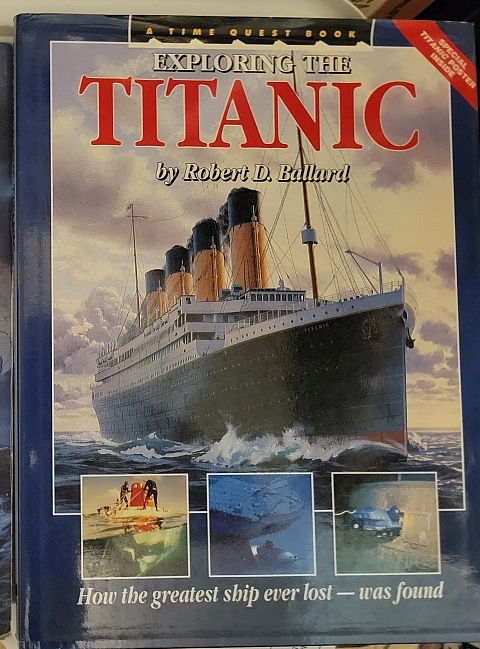
Fast forward a few years, and the wonderful Scholastic Books company has their monthly (or quarterly?) sales flyers going around the classroom. I see a book within that reminded me of that Nat Geo issue. Titanic! I’m sure I didn’t have to bug my parents too much to order a copy of the book – a paperback copy of “Exploring the Titanic” by Robert D. Ballard – but boy, did I sure get my money’s worth out of that book.
I read every page of it over and over, got the timelines of the ship and its discovery. I devoured everything that book revealed about the wreck, the people who died, and the ones who discovered it. The final image in this kid’s book has haunted me for years…
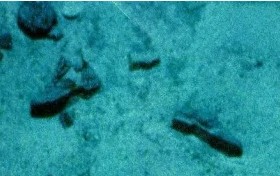
The shoes. The pairs of shoes Dr. Ballard and team discovered on the ocean floor.
Knowing those shoes didn’t land there right next to each other by accident and many were photographed as they explored the wreck. That is Grade-A trauma inflicted on an elementary school kid who just like learning about history. I learned a lesson that day, when I received the book at school and flipped to the last page: history is full of horrible things done to people.
As a teenager, I wandered through a bookstore in my hometown – COAS Books, if you’re ever in Las Cruces – and saw a book that looked kinda the same, but different.
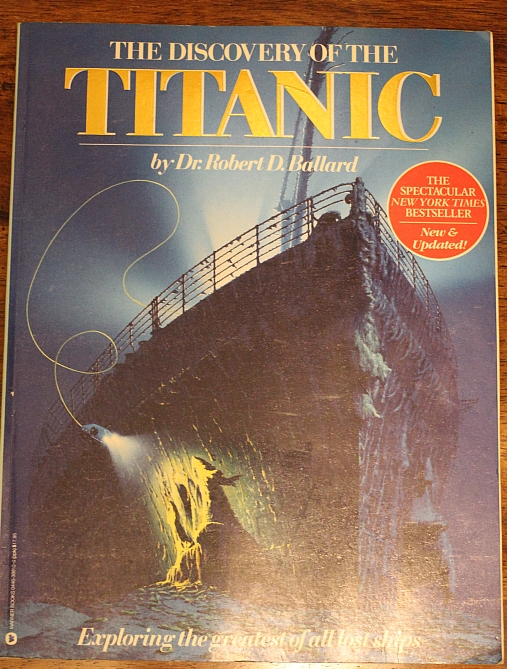
This book, “The Discovery of the Titanic,” gave me a better appreciation to what Dr. Ballard’s team did during the lead-up to the discovery. His background with the U.S./French Project FAMOUS (French-American Mid-Ocean Underwater Survey), friendship with the French oceanographer Jean-Louis Michel, and the race to find the ship before “expedition funding ran out.”
What the kid’s edition could not tell me were all the facts packed into this book – the trials of the American and French crews searching over the muddy ocean bottom, the false hopes investigating promising pieces of “debris” only to find mud, rocks… and more mud.
But as any good storyteller, Ballard brings the excitement to a fever pitch on the evening of 31 August as he stays for the midnight watch change then heads back to his cabin for a break, and the eventual realization that this expedition, like many before it, may end up in failure.
Twelve minutes to 0100 on 1 September 1985, pilot Stu Harris’ sees something on the video monitor that grabs his attention and gives a laconic reply, “There’s something.” Since Titanic was sunk near trans-Atlantic shipping lanes, the debris Harris spots could be from almost anything.
Then, on the control van’s monitors, items began to break of the monotonous views of underwater mud. Harris spots a familiar shape – circular with punctuated holes on the face. Harris enthusiastically calls out, “Bingo!”
Titanic’s heavy boilers are spotted by human eyes nearly 73 years after hitting the ocean floor. The boilers are a key part of the mystery of Titanic’s location… but more on that in a bit.
The sobering moment came minutes later when someone pointed out, “she sinks in 20 minutes.” The jubilant discoverers were humbled instantly by their re-acknowledgement of the wreck site as a grave. A memorial service was held on the fantail of their ship, with thoughts of hundreds of ghosts in the North Atlantic waters, screaming as they froze to death after the ship’s sinking.
Titanic was finally found.
But unlike Cameron’s romantic tragedy, there is another layer to the story of Titanic, one that has fascinated me ever since I discovered it: the “how” behind the discovery.
“Which leaves us only with the how… and, therein, as the bard would tell us…lies the rub.”
More tomorrow in Part II.
 Joseph T. Page II